𝐈𝐧𝐝𝐢𝐚 𝐂𝐨𝐦𝐦𝐞𝐦𝐨𝐫𝐚𝐭𝐞𝐬 𝐕𝐢𝐣𝐚𝐲 𝐃𝐢𝐯𝐚𝐬: 𝐇𝐨𝐧𝐨𝐫𝐢𝐧𝐠 𝐭𝐡𝐞 𝟏𝟗𝟕𝟏 𝐕𝐢𝐜𝐭𝐨𝐫𝐲 𝐚𝐧𝐝 𝐭𝐡𝐞 𝐋𝐢𝐛𝐞𝐫𝐚𝐭𝐢𝐨𝐧 𝐨𝐟 𝐁𝐚𝐧𝐠𝐥𝐚𝐝𝐞𝐬𝐡
𝗚𝘂𝘄𝗮𝗵𝗮𝘁𝗶, 𝟭𝟲 𝗗𝗲𝗰𝗲𝗺𝗯𝗲𝗿:
India celebrated Vijay Divas on December 16, a day that marks the historic victory in the 1971 Indo-Pak war, leading to the liberation of Bangladesh. Leaders across the nation paid homage to the bravery, sacrifices, and indomitable spirit of the soldiers who played a pivotal role in this decisive war.
Prime Minister Narendra Modi took to social media to express his respect for the soldiers, emphasizing their unwavering resolve and dedication. “Today, on Vijay Divas, we honour the courage and sacrifices of the brave soldiers who contributed to India’s historic victory in 1971. Their selfless dedication safeguarded our nation and brought glory to us,” he wrote, underlining the significance of their valor in shaping the country’s history.
President Droupadi Murmu echoed similar sentiments, calling the soldiers’ ultimate sacrifices a source of inspiration for every Indian. Union Home Minister Amit Shah described the day as a symbol of courage and dedication, praising the Indian Army for its historic achievement that brought about a transformative change on the world map.
The Indian Armed Forces organized commemorations at various locations, including a wreath-laying ceremony at Vijay Smarak, Fort William, Kolkata, by officers from the Indian Army, Navy, Air Force, and their Bangladeshi counterparts. Distinguished freedom fighters (Muktijoddhas) and officials from Bangladesh also participated in the celebrations.
𝑯𝒊𝒔𝒕𝒐𝒓𝒊𝒄𝒂𝒍 𝑪𝒐𝒏𝒕𝒆𝒙𝒕: 𝑻𝒉𝒆 𝑳𝒊𝒃𝒆𝒓𝒂𝒕𝒊𝒐𝒏 𝒐𝒇 𝑩𝒂𝒏𝒈𝒍𝒂𝒅𝒆𝒔𝒉
The roots of the 1971 war lie in the systemic oppression of East Pakistan (now Bangladesh) by the ruling authorities of West Pakistan. Following the partition of India in 1947, Pakistan was geographically divided into two parts separated by 1,600 kilometers. Despite cultural, linguistic, and geographical differences, the central government in West Pakistan sought to impose Urdu as the national language, disregarding Bengali—a move that sparked protests in East Pakistan.
The 1970 elections further exposed the divide, as Sheikh Mujibur Rahman’s Awami League won a majority but was denied the right to form a government. The imposition of martial law and the brutal Operation Searchlight in March 1971 intensified the Bengali nationalist movement. Pakistani forces targeted intellectuals, women, and civilians in East Pakistan, committing atrocities likened to genocide. It is estimated that 2 to 3 million people were killed, and over 200,000 women were subjected to sexual violence during the nine-month conflict.
𝑰𝒏𝒅𝒊𝒂’𝒔 𝑹𝒐𝒍𝒆 𝒊𝒏 𝒕𝒉𝒆 1971 𝑾𝒂𝒓
India, led by then Prime Minister Indira Gandhi, extended support to the Bangladeshi freedom movement. Millions of refugees from East Pakistan sought shelter in India, prompting the Indian government to intervene militarily after Pakistan launched an attack on Indian airbases on December 3, 1971.
Under the leadership of Field Marshal Sam Manekshaw, the Indian Armed Forces launched a coordinated offensive on both the eastern and western fronts. The Indian Air Force established air supremacy in East Pakistan within a week, while the Navy, led by the aircraft carrier INS Vikrant, blockaded key ports, cutting off escape routes for Pakistani forces.
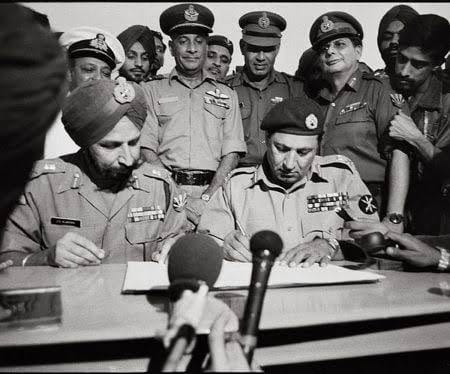
The war concluded in just 13 days, with Pakistan’s General A.A. Khan Niazi surrendering along with 93,000 troops on December 16, 1971. This remains one of the largest surrenders in modern military history and led to the birth of Bangladesh as an independent nation.
𝑻𝒉𝒆 𝑳𝒆𝒈𝒂𝒄𝒚 𝒐𝒇 𝑽𝒊𝒋𝒂𝒚 𝑫𝒊𝒗𝒂𝒔
Vijay Divas is a reminder of the sacrifices made by over 3,900 Indian soldiers who martyred their lives and the nearly 10,000 who were injured. The day also symbolizes India’s commitment to justice and human rights. Eight months after the war, the Shimla Agreement was signed, marking the return of prisoners of war to Pakistan.
Each year, the nation reflects on this victory as a source of inspiration, with the Rashtriya Swayamsevak Sangh (RSS) organizing events like the “Prahar Mahayagya” to honor the warriors and instill a sense of patriotism. The 1971 war remains a testament to India’s military might, humanitarian values, and solidarity with its neighbors.